Iterative Design · Precision Fabrication · Experimental Validation
Overview
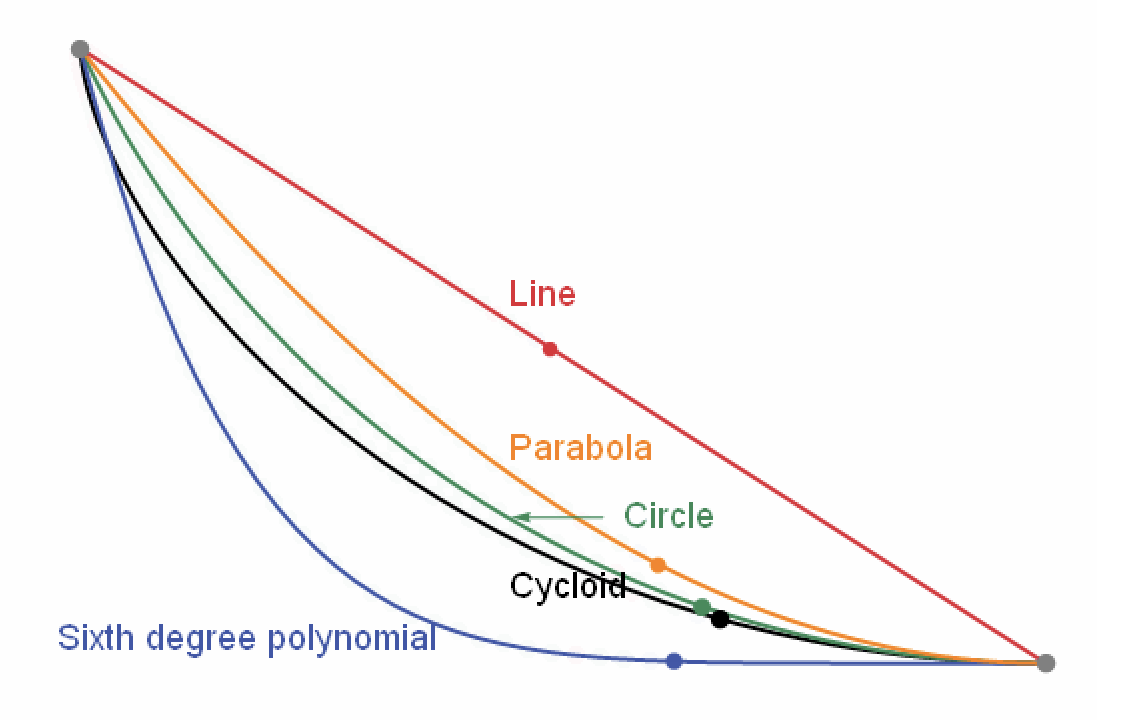
The brachistochrone problem asks: what curve allows a ball to travel from one point to another in the minimum possible time under gravity alone? Johann Bernoulli solved it in 1696: the answer is a cycloid. This project's goal was to build a physical demonstration that makes that result visible and convincing to a full lecture class.
The Harvey Mudd Physics Department needed a race apparatus featuring three track geometries (the cycloid, a straight line, and a high-degree polynomial approximation) that was large enough to see from the back of a classroom, durable enough for repeated semester use, and easy to transport between classrooms.
Key result: The brachistochrone was confirmed as the optimal path: 0.704s average vs. 0.816s (polynomial) and 0.900s (linear) across 5 timed trials, with <3% inter-trial variance. The winner was visible to the naked eye without slow-motion video.
Design Requirements
Three Prototype Generations
Curves were derived mathematically in Desmos and imported into SolidWorks for geometry modeling. The first prototype was 3D-printed in PLA to validate curve equations and test simultaneous release mechanics. Results confirmed the brachistochrone was fastest and that the equations were mathematically accurate. Primary issues identified: surface friction limited time differentiation, and the size was too small for classroom visibility.
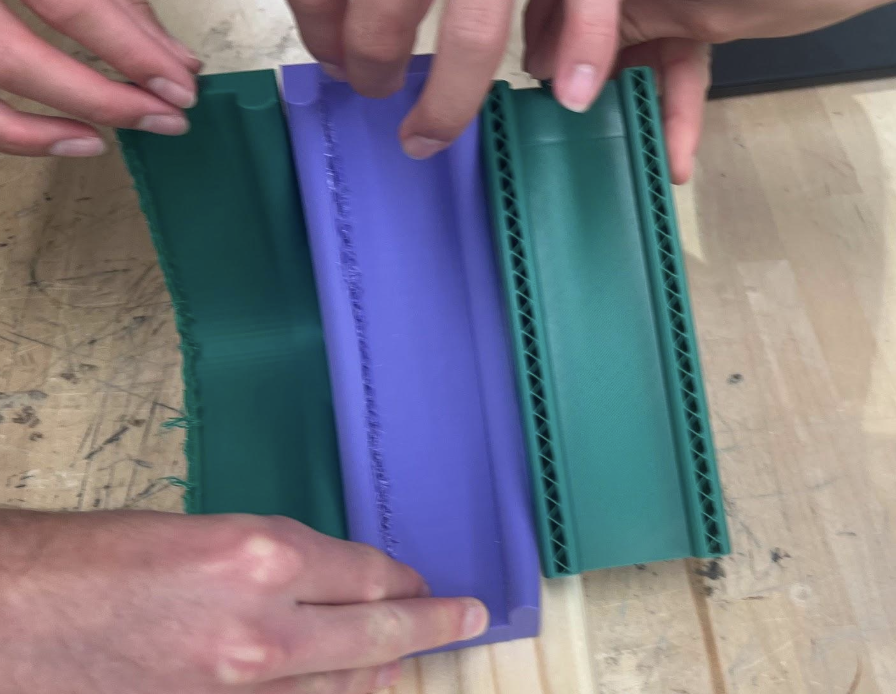
Prototype 1 — 3D-printed PLA
A larger plywood version using 0.25-inch-thick rails, sized to fit within 12×18×15 inches. Key innovation: each track was built from two parallel rails spaced 1 inch apart, allowing the ball to roll between them rather than on a bordered surface. This reduced friction and improved lateral visibility significantly. A PVC pipe hinge mechanism allowed simultaneous release. This prototype confirmed the two-rail approach worked and validated the simultaneous-release design, but remained undersized per client feedback.
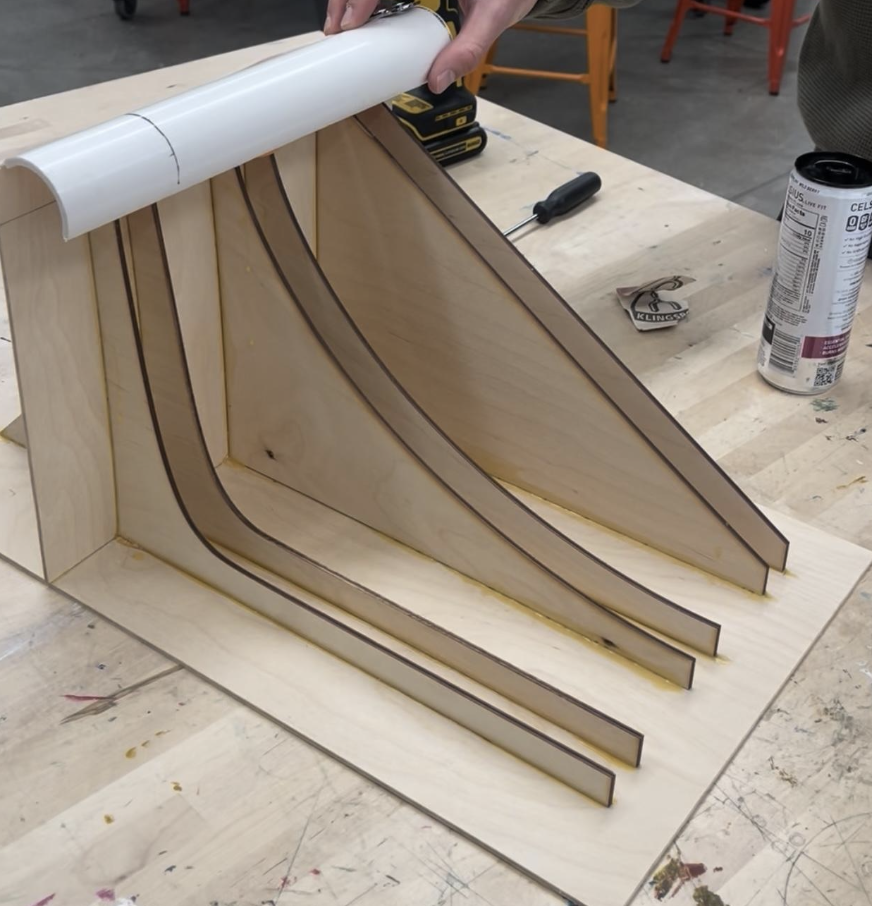
Prototype 2 — laser-cut plywood
After client consultation clarified that visibility was the top priority over the original size constraint, a full-scale version was built from 4 MDF planks (¾-inch stock). Two team members became CNC router certified to enable the larger cuts. The CNC router machined all curves to 0.25-inch thickness — two pieces per curve. Curves were mounted on a shared MDF base with 3-inch spacing between tracks. Wood glue and hot glue secured each curve in place. The release mechanism used a 12-inch half-section PVC pipe with screwed hinges mounted to a back wall, opening upward to release all balls simultaneously. Final weight: 20.7 lbs.
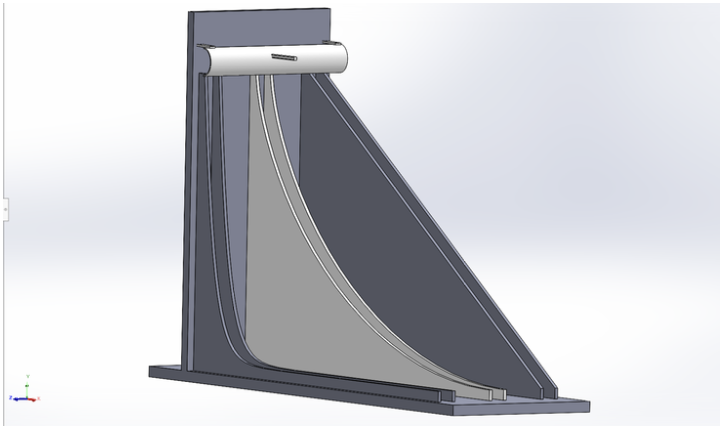
SolidWorks CAD — final design
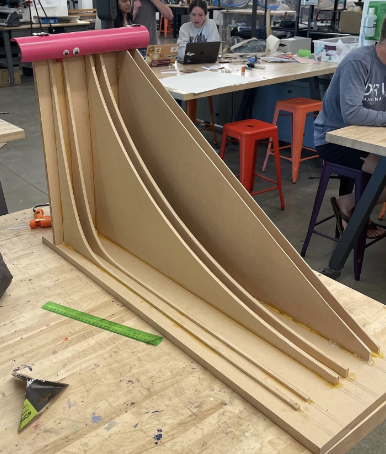
Completed MDF prototype
Experimental Validation
Five timed trials were conducted for each of the three tracks using slow-motion video analysis. Each trial used simultaneous ball release via the PVC hinge mechanism.
| Curve | Predicted | Trial 1 | Trial 2 | Trial 3 | Trial 4 | Trial 5 | Average |
|---|---|---|---|---|---|---|---|
| Brachistochrone (cycloid) | Fastest | 0.71s | 0.71s | 0.71s | 0.70s | 0.69s | 0.704s |
| 20th-degree polynomial | Middle | 0.82s | 0.82s | 0.81s | 0.81s | 0.82s | 0.816s |
| Linear | Slowest | 0.92s | 0.90s | 0.89s | 0.89s | 0.90s | 0.900s |
The brachistochrone was 21.8% faster than the linear path and 13.7% faster than the polynomial approximation. The ordering matched theoretical predictions exactly. Results were highly consistent, with inter-trial variance under 3% for all three curves, confirming the result was repeatable and not measurement noise.
The winner was clearly distinguishable to the naked eye in real time, without needing slow-motion video, giving exactly the visibility the client needed for a live classroom demonstration.
Accuracy score (client metric): 5/5. The brachistochrone was clearly the fastest curve.
What I'd Do Differently
The MDF surface, while smooth, still introduced some friction variability. A polished aluminum track or PTFE-coated surface would reduce friction and make time differences more pronounced at smaller scales, giving the demonstration more dynamic range for future physics classes.
Replacing video-analysis timing with photogate sensors and a digital timer would eliminate measurement uncertainty from manual frame-stepping and allow more precise statistical analysis of the results.
The simultaneous release mechanism worked reliably but could be improved with a spring-loaded gate for more consistent release forces, particularly relevant for the steep polynomial curve, which required a compensating lip on the current design.